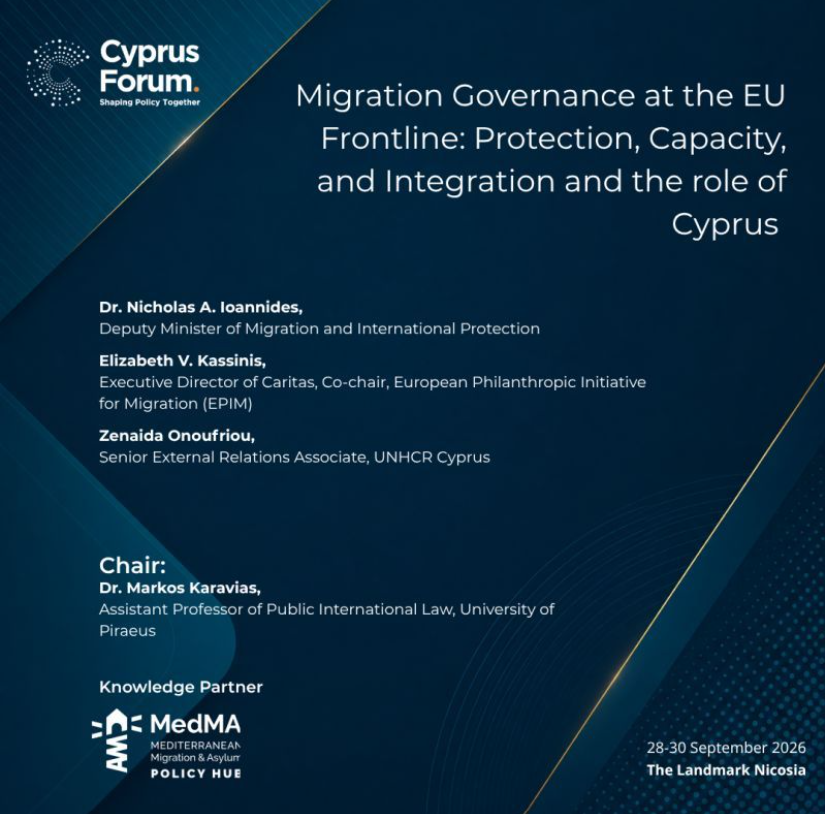
How can Cyprus’ migration policy balance protection with control? At this year’s Cyprus Forum, organized by Oxygen for Democracy, the panel “Migration Governance at the EU Frontline: Protection, Capacity, and Integration and the Role of Cyprus” brought together Dr. Nicholas A. Ioannides, Deputy Minister of Migration and International Protection; Elizabeth Kassinis, Executive Director of Caritas Cyprus-Κοινωνία and Co-chair of the European Philanthropic Initiative for Migration (EPIM); and Zenaida Onoufriou, Senior External Relations Associate at UNHCR Cyprus. The panel was moderated by Dr Markos Karavias, Assistant Professor of Public International Law at the University of Piraeus and curated by MedMA Cyprus.
Deputy Minister Ioannides noted that solidarity is a main pillar of EU migration policy and is manifest in the relocation missions that Cyprus has carried out as well as in the recent relocation agreement with Lithuania. In terms of integration, he added that a national integration strategy was approved by the Council of Ministers in February 2026 is now being implemented.
Reflecting on the EU Pact on Migration and Asylum, Ms. Kassinis warned against losing “our heads and our hearts”. The Pact was born out of a sense of crisis and is an imperfect (and political) compromise. Its implementation must be well resourced and uphold human dignity. Meaningful integration depends on practical conditions. To illustrate, she noted that a single bus ride in Cyprus costs more than in Brussels, Paris or Berlin and can be unaffordable to those who depend on material benefit conditions. Likewise, without access to child care, many women cannot participate in the labor force.
Ms. Onoufriou highlighted the fact that any functioning migration governance system must provide for the safe and dignified return of people who may not need international protection. Any return hub arrangement must respect human rights, she argued. Only people with a final decision on their status should be referred; detention should be a last resort reviewed by a judge; and decisions involving children should be made in their best interests. Seventy-five years on, she said, the Refugee Convention remains as relevant as ever and focus should increasingly and explicitly be placed on responsibility sharing.